Dr Fuhrman

Dr. Fuhrman

Saturday, 4 March 2017

Live: Living up a birthday

I wrote a post on my 57th birthday and how I spent it on my UK blog. Do take a look >>>

Read THIS.

I had always wanted to see what Ma Kelly's looks like inside. In the end, it was just another pub, but what I liked about this one was that it has eight live shows with singers and, sometimes, dancing girls, every day. I was witness to two singers as my friend Luckey, her friends Robs and Lydia and I whiled the evening away with drinks and some peanuts. Here are a few photos:

The stage

The stage 2

With Grace, who is known to me

Luckey (centre) and her friends Roberto and Lydia with me

That's all here ... Live a full life!
Oh yes, I danced a lot.

Tuesday, 28 February 2017

Drink: Water and other fluids - What? How much?

Let me say this right at the beginning. One should not over-drink. That is as problematic as under-drinking. Thus, we are talking about an OPTIMAL quantity of water to drink. In this post, I am going to talk about drinking water and other fluids in the right amount. 


It is obvious that we cannot survive indefinitely without water. What is not obvious, however, is that one should drink an optimal quantity of water. What constitutes an optimal quantity is a matter of debate, but it seems that we have arrived at a consensus. We should all drink at least 6-8 8-ounce glasses of water or other acceptable fluids every day.

This simple 8X8 rule is quite useful and makes it easy to remember. What are the other fluids we can drink instead of water? Well, we can have one glass of a fruit juice or smoothie, one or two glasses of tea or coffee or low-fat milk, and the rest as plain water. Sparkling water is acceptable if you don't enjoy the taste of plain water. Drinking more than one helping of fruit juice or smoothie is not advisable as these often contain a lot more sugar than is healthy for us to have, and also lack in fibre - something we should try and get from fresh fruit and vegetables.


To reach the optimum of 5 helpings of fruit or vegetable, we should count our juice or smoothie as ONE helping, regardless of how much we actually drink; the remaining 4 helpings should be in the form of fresh and raw fruit and vegetables. In fact, there is new thinking on this issue and the newest recommendations in the U.K. suggest that we should be having TEN, not five, helpings of fruit and vegetables. 

I have come across some articles that say men should have MORE water than females. I could not understand why, unless we are stereotyping males to be bigger than females. According to those recommendations, females can get by with the usual 6-8 glasses of water. Men, on the other hand, need 10-12 glasses. 

We should remember that if we reside in hot, dry regions of the world, it is even more important to keep ourselves properly hydrated with frequent drinks of water or other liquids. 


What drinks are not advisable: Carbonated beverages - because they are very rich in sugar; sweetened juices - for the same reason; full fat milk - because they are rich in calories; excess of tea or coffee - as they are rich in caffeine; and energy drinks and sports drinks - again, because they contain a lot of sugar, and the energy drinks are rich in caffeine as well. 

Why not drink an excess of water? This is because an excess is not physiological, and may lead to what is called water intoxication, a potentially lethal condition of dilution of blood and all our body fluids, causing electrolyte imbalances and irreversible brain damage that can kill us.

To summarise:

  • Drink at least 6-8 glasses of fluids, water being the best.
  • Restrict the intake of fresh fruit juices to about 1 glass of 150 ml per day.
  • Drink more if you are thirsty.
  • Drink more if you sweat a lot, e.g. in a hot environment.
  • Substitutes like tea, coffee, low-calorie milk, dilute yogurt, smoothie, fruit juice or sparkling water are acceptable within limits.
  • A well-hydrated body means more energy, a younger-looking skin and radiance that will stand by you all the time.
Thanks for reading. Do write your comments below.

Wednesday, 15 February 2017

Live: Long Life - One step at a time

Most of us are either too aware and mindful of the need to exercise - and carry on with it - or are aware of its benefits and yet, continue to shun it. Let me say this then: we should all try a little of it every day. The mantra in the past was to exercise a lot, combine aerobic work with strength, and generally eat carefully to live a long, healthy life. And yet, who among us has not seen men and women who live a hedonistic life and live into the ripe 90's, while health-conscious, exercise-loving younger men and women die like withering leaves that fell from the tree on arrival of the autumn wind?

The last word on the right combination of needed activity levels and food quality and type to live a long life is not yet written. Even as you read this, research on the best way to increase longevity is being done all over the world. It seems that longevity is coded into our DNA. The longer our "telomeres" are, the longer are we likely to live. To understand this, let me first show you what your telomere looks like:


The above is a simplified image of a chromosome of an adult cell. We have 23 pairs of these (one of each pair from each of our parents) in every one of our billions of cells, The chromosome is made up of DNA - which in turn is made up of amino-acid pairs called nucleotide pairs. The terminal pink portions of each of our chromosomes are known as the telomeres (Greek: telos =end and meros = part). 

Trials have shown that people who eat a vegetarian diet rich in fibre, olive oil and greens AND do moderate exercise every day have a 10% increase in the size of their telomeres. Thus, the DNA on the end of our chromosomes determines how long we are going to live. 

So, how do we go about it? It is easier to do bite-sized exercises multiple numbers of day than to devote, say, 45 minutes of uninterrupted exercise like walking briskly, running, or, for example. In the same fashion, try small changes in your daily diet and try not to convert your diet in one overnight go. 

Do write back to me on what your routine is. Thank you.

Sunday, 12 February 2017

Recipe: Masoor Pulao and kadhi

There are pulaos and pilaus and pilavs galore when you search for any of these words on a search engine. None, however, resembles this unique recipe that is a Bohra speciality. I am going to go over it step by step this time. None of the general kind of talk. Let's get serious. We'll first make the PULAO.

Now, masoor is nothing but BROWN lentils. This is what they look like: 


The ingredients are as follows:

  1. 1 cup of brown lentils
  2. 2.5 cups of rice (choose basmati, but you can make the pulao with long rice, brown basmati rice or even other kinds of rice - except for the ones that are parboiled or sticky)
  3. Onion - 1 medium, sliced thin
  4. Tomato - 1 medium, diced
  5. Freshly chopped garlic - 1 clove
  6. Cummin seeds - 1/2 tsp
  7. Olive oil - 1 tablespoonful
  8. Salt, to taste
  9. Green chilli - 2, cut into 1 inch long pieces
  10. Curry leaves (6-8, optional)
  11. Ghee (clarified butter) - 1 tsp


Preparation: You will need to soak the brown lentils for about 3-4 hours so that they become a bit bigger and more nutritious. You may even want to keep them overnight in your refrigerator. The rice should also be soaked for a while, although not as long as the lentils.
  1.  Cook the lentils with water, salt, and a little turmeric (optional) in a covered pan for about 10-12 minutes on high flame. This should render them soft, but not mushy. The grains should still have some texture when put in your mouth. Alternatively, cook them in a pressure cooker for just one whistle or for 3 minutes, whichever is less. 
  2. Drain off the lentils, but keep the water aside. This will be needed to make the kadhi.
  3. Take a stir-fry kadhai (see pic alongside).  
  4. Heat the olive oil, and when hot, stir-fry some cummin seeds, a few curry leaves (optional) and the green chillis in it. Add the sliced onion and stir fry them till the onions turn golden brown; next, add the diced tomato and cook till the tomato looks appropriately softened. You might want to add some freshly chopped garlic too. This will enhance the taste immensely. 
  5. Once fried to your liking, turn the gas to sim, and add the brown lentils to the mix. Continue stirring for another 3 minutes and then take the kadhai off the gas. The lentils are ready.
  6. Next, cook the rice with your method of choice, making sure that they are about 75% cooked and not soft or ready to eat. Set the rice aside. 
  7. You are now ready to make the amazing pulao. Take your storage-cum-serving vessel and mount it on the stove with simmering heat. Rub the inside of the vessel with some clarified butter (ghee) and then put about 20% of your cooked rice on this to form an even layer. Pour all of the brown lentils on this and spread this again so that it forms a flat top layer. Next, put the rest of the rice over this, so as to cover the lentils completely. This should look like this: 
  8. You may temper the top of the rice with some "birasta" (that is thinly sliced long onion that is sauteed until they are dark brown in hot oil). Voila. your pulao is now ready.
Let us now see how to make the kadhi. Essentially, kadhi is nothing but a kind of soup made with chick-pea flour (we call it besan in Indian languages) and yogurt. The simple method of making kadhi is really endearing. 

The ingredients for the kadhi are as follows:


  1. 1/2 a cup of thick yogurt - if kept for a few days outside the refrigerator, it will become a bit sour, and that is the ideal.
  2. 1-1 1/2 tablespoons of chickpea flour.                       
  3. Curry leaves - 8-10 nos
  4. Onion - 1, small, diced into thick pieces
  5. Fenugreek seeds - 1 tsp    (see photo)                                 
  6. Cummin seeds - 1/2 tsp
  7. Turmeric powder - 1 tsp
  8. Red chilli powder - 1 tsp (Alternatively, you may use a few green chillis as well, cutting them into 1-inch long pieces)
  9. Cooking oil - 1 tablespoonful
  10. Salt, to taste.
  11. Water saved from the brown lentils (this is the most crucial ingredient - I hope you remember saving that!)

Preparation: There are traditional ways, and there is the Taher-way, which is, simply put, a convenient way, of making the kadhi. What I do is to use a mixer to blend the yogurt and the chickpea flour. Keep this ready. You may even add the salt to this blend.

  1. Take a cooking pot. Add the cooking oil and heat till ready to accept all the stuff we are going to throw in. 
  2. First, add the curry leaves, wait till they splutter. Next, quickly add the cummin seeds and the fenugreek seeds, and as they splutter, reduce the gas to a sim. Now, add the onions and cook till they are pink to light golden brown (don't turn them to a dark golden brown - the crunchiness of the onion in your mouth is a texture to savour).
  3. Add other spices like the turmeric, red chilli powder and, if you wish, some more garlic. Once these are smouldering, add the blended mix of the flour and yogurt, switch the heat back to full and cook for the next few minutes, stirring the whole thing so that the flour gets a bit of a roasting. As the mix dries up, add the brown lentil water to it, slowly, and continue to stir. Once it is all in, turn the heat down and cook for a further 10 minutes. 
  4. Some families add tomato to the kadhi as well. I think this is not needed if the yogurt is aged and sour. 
  5. Turn off the heat and your kadhi is now ready. You can garnish it with fresh, chopped coriander.
  6. To enhance the whole experience, you can add some previously made onion bhajis* to the kadhi. This is known as pakora kadhi or bhajia kadhi. I think this combination goes better with a traditional, non-brown lentil kadhi made simply with masoor dal khichdi and the water of the masoor dal. But, I leave it to you to try it and let me know how this works.  
And that, my friends, is what masoor-pulao kadhi is all about. I will end this with a picture of the final product served on my dinner plate. The photo is not artistic, but I am sure you will get the picture. I put just a little kadhi on the side, but you should actually put a whole lot of it to get the best out of your cooking! Enjoy.


Do let me know how it turned out for you. Cheers. Ah, well, the British would, after serving the food, choose the best wine to go with the food. I am NOT going to do that. The possible combinations that go well with masoor pulao kadhi are - an empty stomach, some lime pickle (Indian style, sour, with mustard seeds) and roasted popadoms.

*bhajis is the same as pakoras. Will write a recipe soon.

Saturday, 28 January 2017

Review: Mr Basrai's World Cuisines, Blackpool

When you visit Mr Raghubir Basrai's outlet in Blackpool, you can't imagine it began just10 months ago! This big outlet at Cookson street in Blackpool is now full on most evenings, and it isn't hard to see why.

Mr Basrai's World Cuisines is a family-run business and arrived in Blackpool last year. Located near Blackpool's town centre, this restaurant with nearly 350 covers is possibly the best thing to happen to this town when it is facing a downward trend in the places tourists visit in the UK.  It offers multiple cuisines from around the world - all in an eat as much as you like buffet. The price is also very reasonable, considering that it includes over 50 different main-course items and another 50 or so items from within the starter and dessert menus. Most items are prepared fresh as you wait for it to be served on your plate, except for the standard Indian, Chinese and Japanese items, which are prepared beforehand and are available to take on your plate directly from containers which are being constantly heated electrically from below.

I have been to this place 4-5 times since it opened. While my first visit was when I was by myself and had just returned from an outing from outside Blackpool late evening, the rest of them have been in the company of either my family (when they were in the UK with me in October) or my friends.

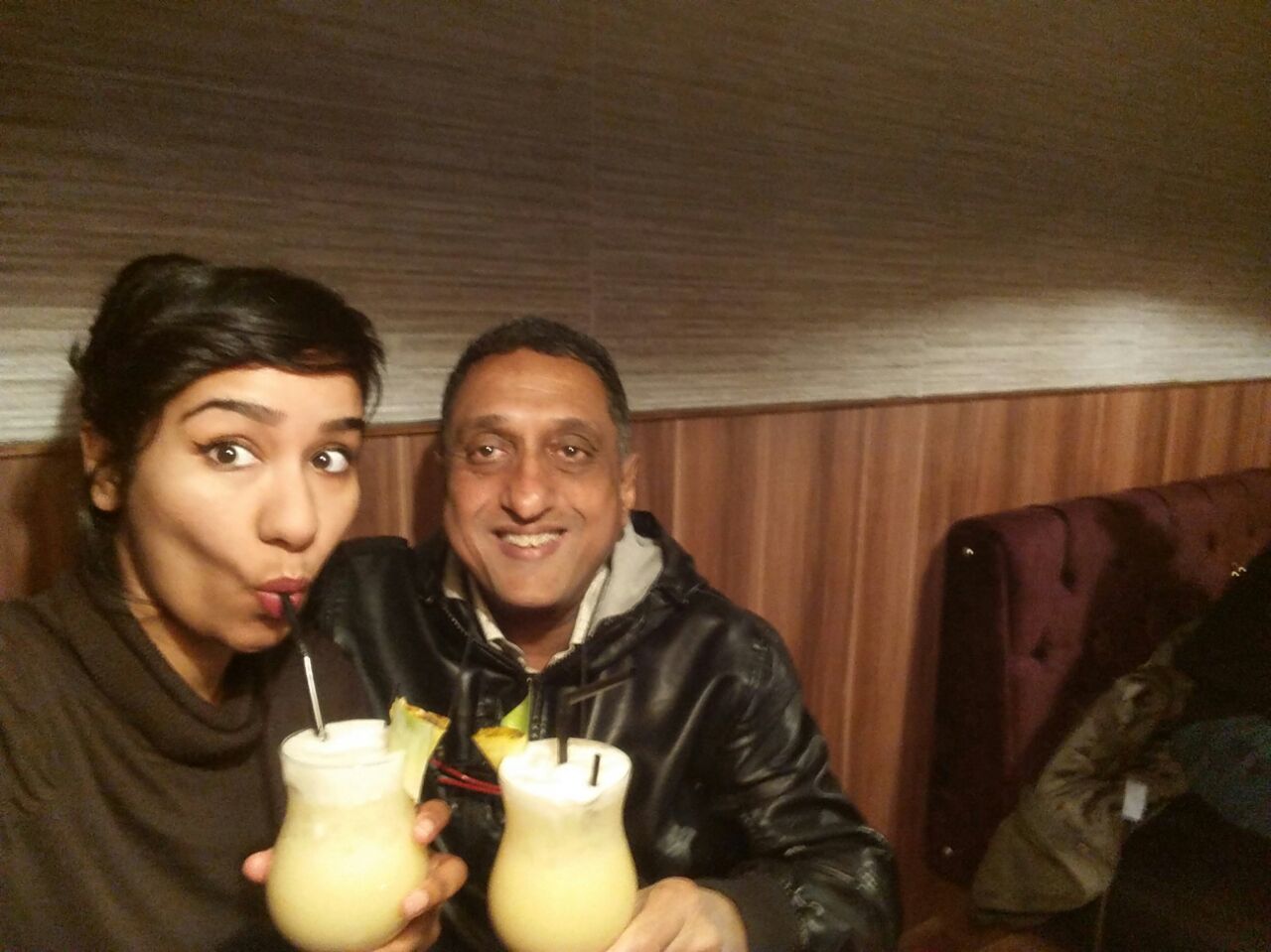
This time, it was with my dear colleague and friend Luckey Kaur, and we went there on the 27th of January 2017. It was a no-reason dinner outing, and we decided to make the best of it as both of us were free the next morning. Beginning with a Mr Basrai's famous cocktail, we then proceeded to have a great time.

The beauty of it all is that Mr. Basrai himself attended to us. When we told him Luckey was a Punjabi too (as is Mr Basrai), he was quite happy to extend special hospitality services to us. His son, Rajbir, who normally minds the till, first went and found us both a cosy table at the back, then kept sending waiters with smiles to ask us how the meal was and whether we were enjoying ourselves. Here are some pictures of the two of us having a gala time.

Samosas and tikkis with chhole
Enjoying the Mr Basrai's special cocktail

Dessert that Luckey had
The chaat we had

The huge collection of starters

Both of us enjoying a selfie and the desserts
Dessert that I had
Having fun
 Additionally, we also ate a main course of noodles with vegetables and, in my case, prawns as well. Wow! When we were about to settle the bill, imagine our surprise when Mr Basrai sent us back to our table and then sent a complimentary cocktail each! We were pleasantly surprised. He was all smiles as we greeted him while leaving and, I suppose, it was a great gesture by him to make it 100% certain that I would return again to his place for a good time.

Ratings:

Food: 5 stars
Décor: 4.5 stars
Hospitality: 5+ stars (he he).
Costs: Great VFM, hence, 5 stars
Location: 5 stars, unless you live away from the town centre. 

Sunday, 22 January 2017

Recipe Tips: Dal gosht

Okay, so everyone knows how to make dal, right. It is quite an easy job to mix different dals, combine them with tomato and spices, cook it all together and serve it as a soup. However, when it comes to making finger-licking good dal, it does need a bit of learning. 

I make dal the traditional way Bohra Muslims do. It is a kind of thick, spicy dal. It doesn't have the sweetness and dilute texture of a Gujarati dal; neither does it resemble the Dal Maharani. It is more like the tadka dal of the north. 

There are two ways to spice up dal. One way is to temper it from over the top after the dal has already been cooked. The second way is to start a tempering in a kadhai, and then add the cooked dal over it. You could go either way. The most essential steps are thorough cooking of the dal, using a hand mixer to homogenise the dal (if it hasn't done so already with the cooking) and using spices in the right proportions. 

During the initial dal cook, use only turmeric, whole green chillis and salt, with tomatoes. In the temper, first splutter cummin seeds and mustard seeds, then add the long, thin onion; after the onions have turned a pink-brown, add garlic paste, temper further, then add ground spices like coriander-cummin powder, garam masala, red chilli powder, etc.

The lamb pieces you use to make the dal gosht must be from a tender animal. I use lamb chops with bone in; you may want to use other portions. The shoulder or the shank are equally tender. Again, there are two ways to cook the lamb. You may either marinate the lamb pieces and then add them to the cooking dal so that it all cooks together, or you can cook the lamb separately and then combine the dal with it at the last step. Regardless of which way you go, you do need to make sure that the lamb meat is properly cooked. 

For the meat marinade, use tomato paste or live curd along with powdered spices, a ginger garlic paste and salt as per taste.

I have often found that using whole green chillies during the initial cooking of the dal in a pressure cooker gives you a satisfying pungency with the freedom to eat those pieces of chilli with your dal or dal gosht. Others may prefer small red chillis or red chilli powder. Again, that is your personal preference. How much chilli to add is also a personal thing. The same is true of salt. I do advise adding salt into the dal initially rather than adding it as a last step to "season as per taste".

Finally, what do you eat the dal-gosht with? Well, freshly cooked basmati rice is one option. I usually stir in a few chapatis broken into bits. And garnish the whole mix with onion kachumber - the simple thin diced onions with coriander, diced green chilli and lime juice. 

Try these tips and see how your dal-gosht turns out. 

Do you have your own tips on how to make dal-gosht? Do share them in the comments section.

Saturday, 21 January 2017

Review: World Streat Food, Mumbai

On the 13th of January 2017, my family and I went to this new place located at the Dalamal Tower in Nariman Point in Mumbai. Find the location HERE.  World Streat Food is a recently opened restaurant (to be precise, it opened in August 2016). Its concept is simple: make available street food from around the globe in the comfortable environs of a restaurant where you can sit and eat them at leisure. 

In my conversation with their marketing manager Ms. Shachi Mody, I learned a bit more about this eating out place. It is one of the several eating outlets that have opened or are opening in the city of Mumbai. Even as we ate, one more outlet of this chain is being readied to be opened within a few months, Ms Mody informed me. The entire chain is owned by an Indonesian businessman of Indian origin and their website lists all their other ventures as well as outlines their vision etc. 


Review:

When we reached the place (without a reservation), we found it to be fairly full, but there were a few empty tables and we were seated immediately. 


Blueberry smoothie
We began our journey down the lanes of Asia with a Tom Kha soup with chicken. My daughters do not have soup, hence they ordered mocktails - while Inas ordered the strawberry shake, Hannah had the blueberry smoothie - and both were very tasty indeed. 


  While we were having our soup, we observed that the waiters were very busy entertaining a food reviewer at the next table. This lady had a professional photographer who kept taking pictures of each dish as it was brought to the table. Presently, we began to converse with her. She was Geeta Sridhar, and she is a top reviewer for Zomato. She also has a food blog - and it was her blog that actually stimulated me to start this food blog as well! 


The family: awaiting our food

After the soup and the shakes, we ordered a starter in the form of Kung Pao chicken dumplings. This dish was steaming hot when it arrived at our table. It was within a bamboo container. The dumplings were quite delicious and not at all spicy. 


 For the main course, we chose a Sri Lankan Chicken Kottu Roti, which, actually, was delectable. We got so busy eating, I forgot to take photos of the newly arrived dish. 


After this, we had the Mozambique Jerk Fish and finally, the Sumatran Lamb rendang. This was a rice and lamb dish that literally tasted like Indian or Mughlai lamb and rice, only, it had the oriental flavours that we liked a lot. For the dessert, we ordered a three-flavoured pannacotta, at the recommendation of Ms Mody. It was really nice. 


The entire meal was great. And it was quite reasonably priced. I think it set us off by a little less than INR 2000 - which, if you believe me, is less than 25 British pounds! 

Rating:

Food: Five stars
Service: 4.5 stars
Ambience: 4.5 stars
Cost: 5 stars
Excitement ratio: 4.9
Overall rating: 4.5 - 5.0 stars.

Recommendation: 

Do visit on weekdays if you don't want to wait. I think the exact foods you might want or really enjoy will be different from mine, but if you choose any thing we ate, you will really enjoy yourself. 

Wednesday, 18 January 2017

Eat: Why should one eat out?

More often than not, eating out is more about having a good time rather than getting good nutritious food. On some occasions, though, it could be that you really get healthy, nourishing food. 

I usually eat out because it is not always possible to create exotic dishes in your own home kitchen. Even if you are able to do so, you will face great difficulties in assembling more than one dish on a single day of eating. The second reason, is, of course, getting the whole experience dished out by the restaurant. A theme restaurant is one example. I once visited a restaurant with a jungle theme in Mumbai. It had trees, manikins of animals, drum and wind rustling music, and dark cave-like seating places. Another example of an experience would be eclectic food that would be too much of a bother to learn to prepare by oneself. The third reason I can think of is to eat out with a group with similar likes and dislikes. Every visit I have made to a restaurant has been for one or more of these three reasons. 


An aspect of dining out that I particularly enjoy is being able to eat at leisure, This does, however, beg an explanation. It is not that one CANNOT eat at leisure within one's home. It's just that at a well-heeled restaurant, one is able to enjoy this without worrying about someone knocking at the door, or you having to fetch the ready dish from the kitchen, or, as is usual, keeping an eye on things simmering on the stove or heating in the oven. All this adds up to too many distractions, and is certainly not something I would welcome when I am in the mood to enjoy my dinner!


Let me also tell you that there is yet another reason for me to eat out. This reason is about feeling as if you are embarking on a new adventure, discovering a new place to eat, or a new form of cuisine, or a new aspect of eating at a particular place that you haven't experienced before. The new aspect may be about eating in a different way - for example, an innovative buffet, or a barbecue that is working for you at the table where you sit (such as the one I enjoyed at Barbecue Nation at the Atria Mall in Worli, Mumbai); or, even something as exotic as eating in an underwater restaurant! Alternatively, it may be about meeting new people at your adjoining table, and making friends with them for life; finally, it may be that this is the one opportunity you have of advancing a relationship that was not going as well, or that you wish to take a step further. 


Finally, for an NRI like me who stays overseas without his family, eating out with the family is joy unparalleled. It enables me to connect with my wife and daughters simultaneously in a quiet environment where we cannot easily shed our social masks and get down to an argument or unpleasantness that is often common in a family. 


So, there. Why do you eat at a restaurant or eat out? Do share your own comments. 

Tuesday, 17 January 2017

Live: My views on eating right


Eating with pleasure makes it nearly right every time. This is the bottom line when it comes to eating. There is a very thin line between eating to live and living to eat, at least in my case. Sometimes, I weigh in on one side, and occasionally, the other. Either way, I am happiest when I am thinking, making, eating or talking food. 

There is immense satisfaction when what you cook turns out just right in taste and flavour. Similarly, I am quite excited to see well-laid out food, a pleasing restaurant ambience, enthusiastic diners (at home or when eating out) and when discussing food.


Don't get me wrong. I am a diabetic, so certain foods are taboo for me in excess. I am also never going to eat pork as I was brought up a Muslim. I do have a small drink of alcohol on occasion, but I would not discuss this in this blog as my experience and knowledge on this are extremely limited. 


I do indulge, however, in gastronomic adventures. When I describe to you these, I am sure you will want to jump aboard the bandwagon and share in the excitement. This, then, is what this blog is going to be about. 


Tomorrow, I will start sharing concrete experiences with you. Ciao.

Foods that I enjoy

I enjoy practically every kind of food. There is little that I do not wish to consume ... and yet, I would not call myself an indiscriminate eater. I will, for example, never say no to a masala dosa, but, if asked where I would love to eat it, I would, most often, indicate a specific place - or a few places - where I would enjoy eating it. 

Also, I savour food. Not just eat it. The preparation is as important as the consumption. This might mean an elaborate preparation where I am planning to eat at a street-side dhaba or a fine-dining restaurant or the actual preparation that goes into cooking a certain kind of food. 


This blog is also about drinking - but, I daresay - I am not going to talk about alcoholic beverages. This will be about drinking in non-alcoholic stuff and about drinking in the fun and the rest of it all. 


Finally, in this blog, I will also talk about life. Life, not as a philosophical subject, but living, breathing life as a co-adventurer on a journey that we will jointly embark on. Welcome ...

Introducing myself

My name is Taher. I was born and brought up in Mumbai, a large metropolitan city of western India and also the country's de facto financial capital. Over and above this, Mumbai is also, in many ways, the melting pot of many different cultures of India as well as the rest of the world. 

To a foodie like me, Mumbai represents the best of the world. From cheap street food to the most epicurean experiences in fine dining places, it has everything. In addition, it fosters experimentation and love of food for anyone who has the time and the inclination to savour its offerings.


This blog is not, however, about Mumbai. It is about food. Hence a bit more information about me is in order. I have been reviewing restaurants, publishing recipes, helping people who search for good places to eat and doing more since many years over the net and off it. Many of my reviews are located at www.tripadvisor.com, where you can find me at THIS link.


I have travelled to many places in India and some outside it as well. I will, therefore, share with you nuggets from my homeland and from wherever else I have been or lived. I spent nearly four years in the Kingdom of Saudi Arabia, and have been living in the U.K. since mid-November 2015. 


I will share cooking tips, some easy recipes, some restaurant reviews, etc. Be prepared to enjoy reading about all these things, and more.


If you are a foodie yourself, do share your views on what I write. Please feel free to comment. Even if you are not a hard-core foodie, I will welcome your comments and views. Do feel free to share this blog with your friends through social media. 


If you are an advertiser related to the food industry, I am open to carry your advertisements on my blog. Do contact me on drtaher@gmail.com for the same.


Finally, if you are a blogger yourself, please do provide your blog link and I will be happy to visit you and share in your happiness. 


Thank you for your visit. Happy eating/drinking and living! Cheers!